Work · Ford
Brand Spike
A 5-metre interactive LED cube that turned people's movement into generative art, then played it back on its other sides.
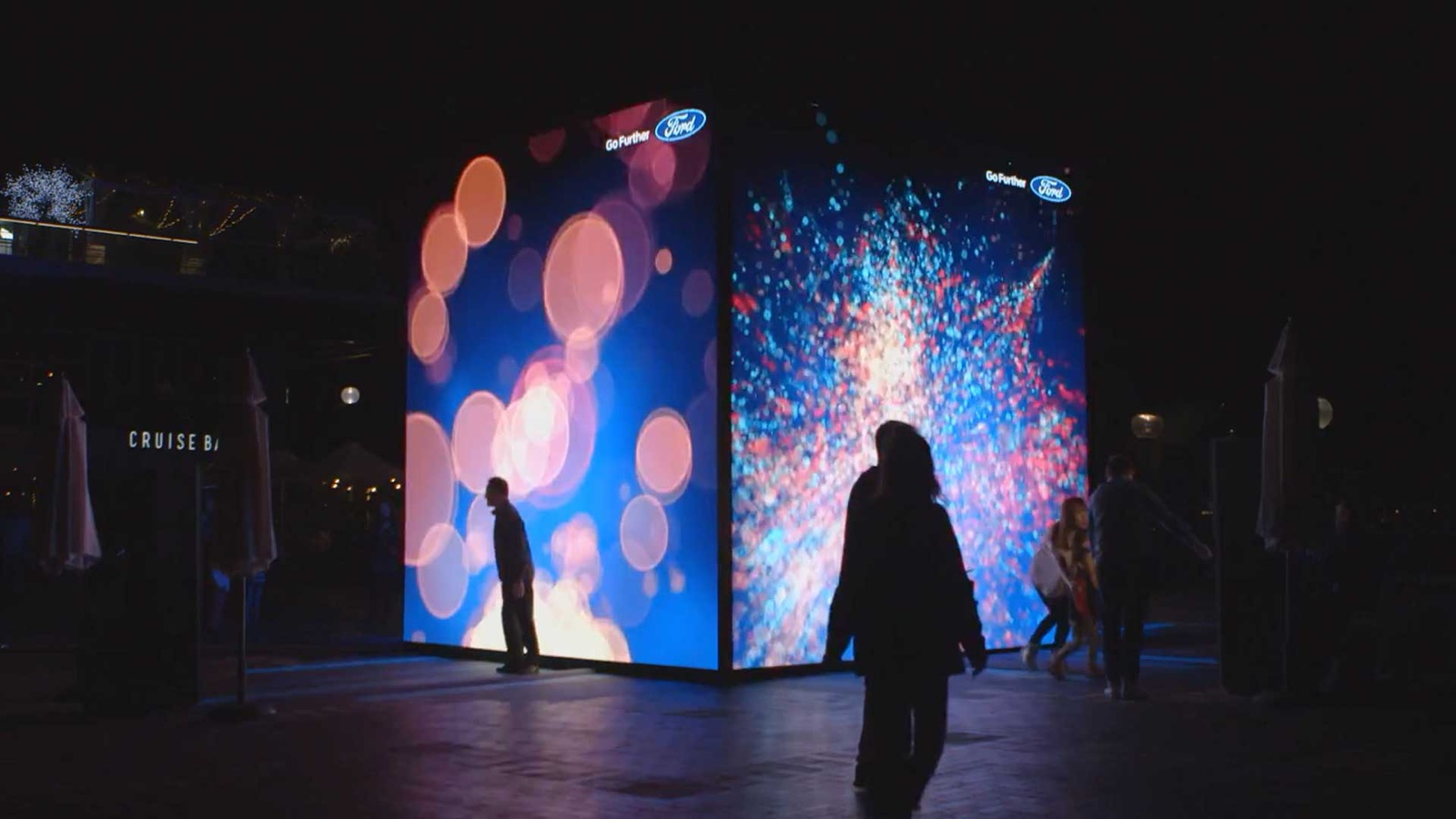
Ford Brand Spike was an interactive LED cube, five metres on every side, that appeared unexpectedly in Melbourne and Sydney. Four of its sides were 7.5 mm-pitch LED tiles. Two of them ran an interactive Kinect- and audio-driven application built in Unity, where people moved 3D objects and particle systems with their body and voice.
The hardest problem was the sun. Kinect’s motion tracking fails in direct sunlight, so we wrote a custom application in Haxe that analyses the raw depth data and estimates where each participant’s head and hands are. When the Kinect can’t provide enough information, our algorithm takes over, and the experience keeps working.
Alongside the main experience, a capture app recorded people whenever it detected interaction, and a playback app showed those recordings on the cube’s two non-interactive sides, turning every visitor into part of the show.
Key features
A five-metre LED cube
A 5 × 5 × 5 m cube with four sides of 7.5 mm-pitch LED tiles. Two sides were interactive; the other two played back what people had made.
Movement and sound, as art
A Unity application let people play with 3D objects and particle systems on the LED wall using their body and their voice.
Tracking in direct sunlight
Kinect sensors struggle outdoors, so we wrote our own tracker that reads the depth data, estimates where people's heads and hands are, and takes over whenever the Kinect can't.
Record and playback
A capture app recorded whenever it detected people interacting, and a playback app showed the best moments on the cube's non-interactive sides.
Video